
























April 8, 2024
Lamborghini creates an exclusive Revuelto through its Ad Personam Customization Program.
- The company customizes livery and unique trim for the V12 HPEV super sports car.






Photos: Lamborghini Revuelto Ad Personam. Images provided by & copyright © Lamborghini.
Sant’Agata Bolognese, Italy, April 6, 2024 - Automobili Lamborghini celebrates the inaugural Lamborghini Arena event with an exclusive Revuelto created by the company’s Ad Personam customization program. The program recently opened its new studio at the Lamborghini headquarters.
The car has a striking exterior with contrasting hues and new carbon fiber elements. The bodywork is painted in Grigio Hati (gray) with details in Verde Scandal (green), highlighting the car’s lower line, roof, mirror caps, and rear diffuser surrounds, along with Verde Chiaro (light green) brake calipers. The rear part features the Italian flag with red, white, and green stripes on the lower surface of the moving wing. Additionally, the hood has two racing-style stripes in Nero Noctis (black), emphasizing the car’s performance attitude as a V12 super sports car.
The roof, rear “contango,” spoiler, air intakes, sill inserts, and other details are made of high-gloss exposed carbon fiber, giving the elements a shiny effect enhanced by the 21-inch (front) and 22-inch (rear) high-gloss black Altanero alloy wheels.
The interior trim matches the exterior colors. It includes black sports seats with stitching and piping in a green hue called Verde Scandal. Additionally, there are carbon fiber plates with “Lamborghini Arena 2024” and “Ad Personam” logos at the dashboard’s ends.
The Revuelto is the first V12 hybrid plug-in super sports HPEV (High-Performance Electrified Vehicle). It is equipped with a 6.5-liter naturally aspirated V12 mid-engine combined with three electric motors, one of which is integrated into the new 8-speed dual-clutch transmission. The vehicle delivers a maximum torque of 725 Nm at 6750 rpm and a maximum power output of 1015 CV.
• Lamborghini Revuelto can reach a top speed of over 350 km/h and accelerate from 0 to 100 km/h in just 2.5 seconds!
Source: Lamborghini
|GlobalGiants.Com|


Edited & Posted by the Editor | 6:02 AM | View the original post
April 6, 2024
Audrey Azoulay meets with Antony Blinken at UNESCO.
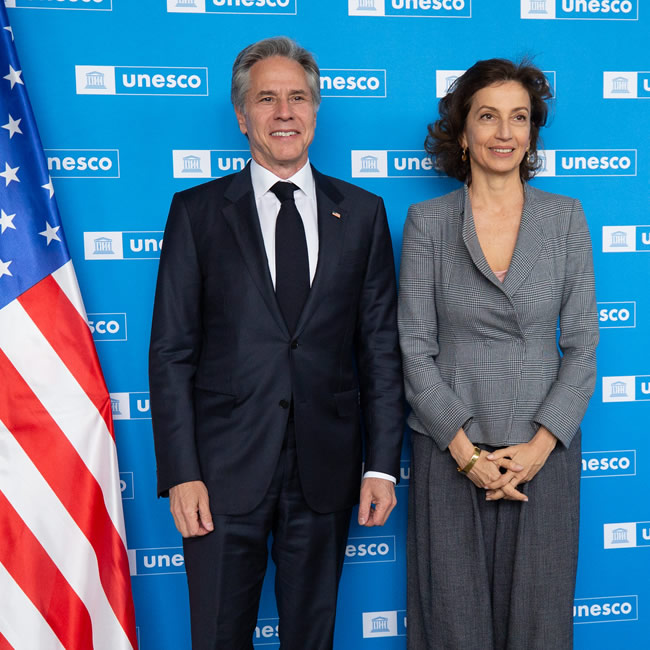

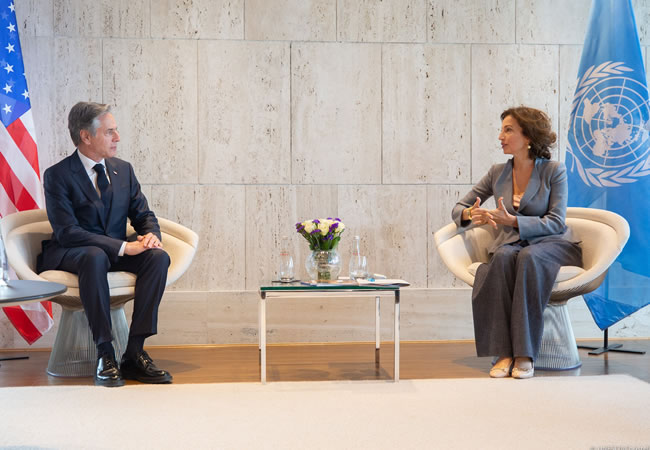
Photos: Audrey Azoulay, UNESCO’s director-general, met with US Secretary of State Antony Blinken at the Organization’s headquarters in Paris. During his visit, Blinken reaffirmed the United States’ enduring support for UNESCO’s fundamental mission, notably safeguarding culture and education. Images provided by UNESCO; copyright © UNESCO/Christelle ALIX.
Paris, France, April 06, 2024 — US Secretary of State Antony Blinken made his first official visit to UNESCO headquarters since the United States re-joined the Organization in July 2023. In a meeting with Audrey Azoulay, he reaffirmed the United States’ total commitment to supporting UNESCO’s mandate for education, sciences, culture, and information.
The Director-General praised the United States’ commitment to the Organization’s multisector priorities, including gender equality, improving access to quality education for all, and globally implementing the Recommendation on the Ethics of Artificial Intelligence, which UNESCO’s Member States unanimously adopted in November 2021.
Audrey Azoulay and Antony Blinken also discussed actions that UNESCO implements in crisis and conflict environments, notably Iraq, Gaza, and Ukraine.
The United Nations Educational, Scientific and Cultural Organization (UNESCO) is comprised of 194 Member States and has its headquarters in Paris. It leads international cooperation in education, science, culture, communication, and information. UNESCO oversees over 2000 World Heritage sites, Biosphere Reserves, and Global Geoparks. Additionally, it manages networks of Creative, Learning, Inclusive, and Sustainable Cities. Further, it operates over 13,000 associated schools, university chairs, training academies, and research institutions.
Source: UNESCO
|GlobalGiants.Com|
Edited & Posted by the Editor | 2:52 AM | View the original post
April 4, 2024
Chandigarh's Hero, Ayushmann Khurrana, signs a Global Deal with Warner Music India.
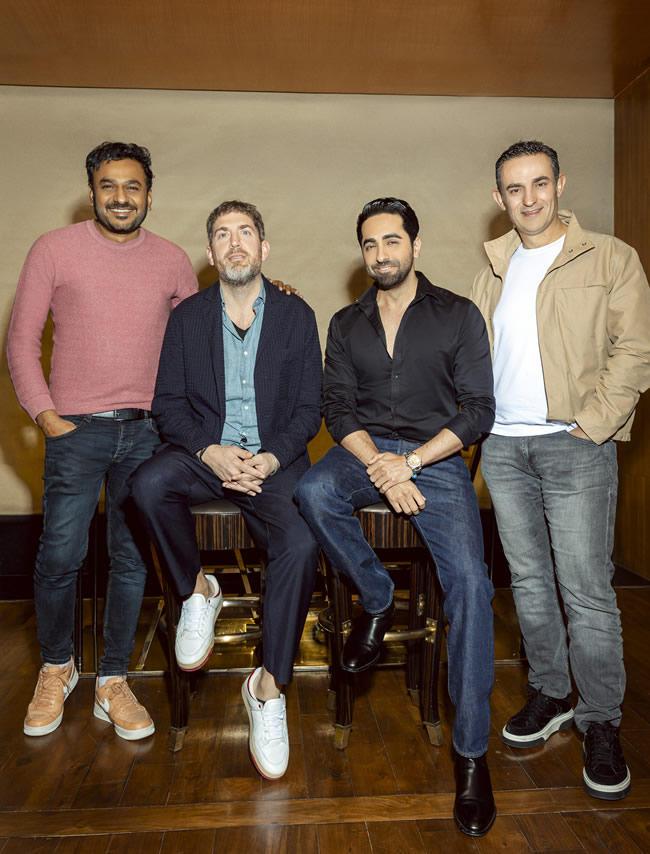

Photo: L-R: Jay Mehta, Max Lousada, Ayushmann Khurrana, Alfonso Perez-Soto. Image provided by Warner Music India, copyright © Warner Music India.
MUMBAI, India, April 3, 2024 — Ayushmann Khurrana, the esteemed Bollywood superstar known as the “Hero of Chandigarh,” has signed a global recording deal with Warner Music India, the country’s leading music label.
• While the Panjab University of Chandigarh has conferred on him its distinguished “Kala Rattan” award, saluting him as a true gem among actors and artists, the people of Chandigarh celebrate Khurrana as an idol for his exceptional performance in “Vicky Donor.”
Signing with Warner Music India will enable Khurrana to access the label’s global ecosystem, helping him connect with audiences and artists beyond India’s borders. The first release from this partnership is expected to drop next month.
Expressing his excitement about the partnership, Ayushmann Khurrana said: “I have always wanted to collaborate with like-minded people in my pursuit of creative excellence. I want to take my music to a global audience, and I’m confident I will make significant strides in this realm with Warner Music India. I cannot wait to unveil my next song to people. It will be a new sound that people haven’t heard from me before, which is extremely exciting.”
Jay Mehta, Managing Director, Warner Music India, commented: “Ayushmann has experienced unparalleled success with his films, and we’re excited to see him now scale new heights as a pop star. With his passion for music, a versatile sonic identity, and our artist-first ecosystem, we are thrilled to build an iconic roadmap for him on his music journey.”
Alfonso Perez Soto, President of Emerging Markets at Warner Music Group, added, “Ayushmann already enjoys immense popularity in India and among the global Indian diaspora. We believe he has the talent and charisma to connect with even more audiences worldwide and become a truly global music and entertainment icon.”
Max Lousada, CEO of Recorded Music, Warner Music Group, concluded: “Ayushmann and his distinctive voice light up the stage and screen, and he has the star quality to captivate audiences worldwide. I’m very excited about the music culture in India right now - its diversity, pace, and dynamism are inspiring - and we have big global plans for our artists and our company.”
Over the past decade, Ayushmann has contributed his voice to numerous iconic pop songs, including chart-toppers like “Mitti Di Khushboo,” “Paani Da Rang,” and “Mere Liye Tum Kaafi Ho,” each accumulating millions of views. Throughout his cinematic career, he has distinguished himself as the only Indian actor recognized for his pioneering use of cinema as a catalyst for social change.
Source: Warner Music Group
|GlobalGiants.Com|
Edited & Posted by the Editor | 10:13 AM | View the original post
April 1, 2024
Prime Minister Modi releases Commemorative Coin to mark 90 years of the Reserve Bank of India.
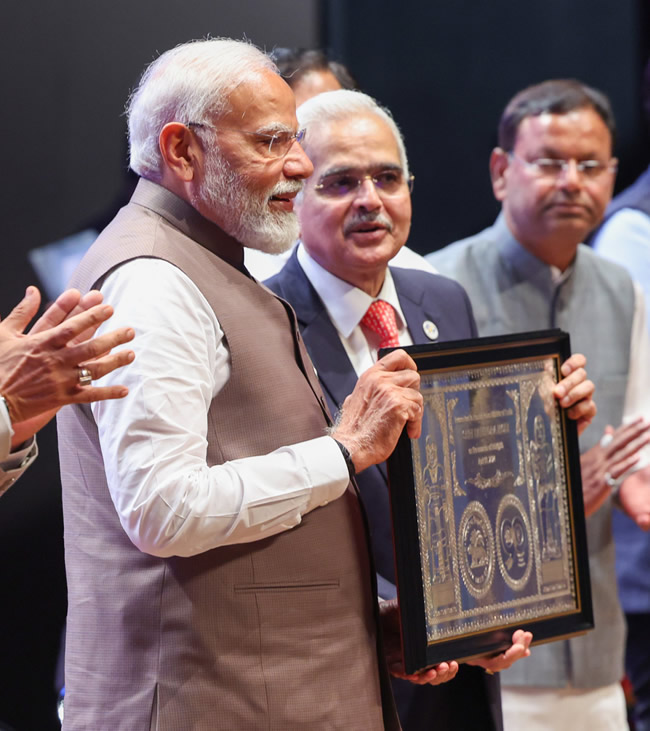
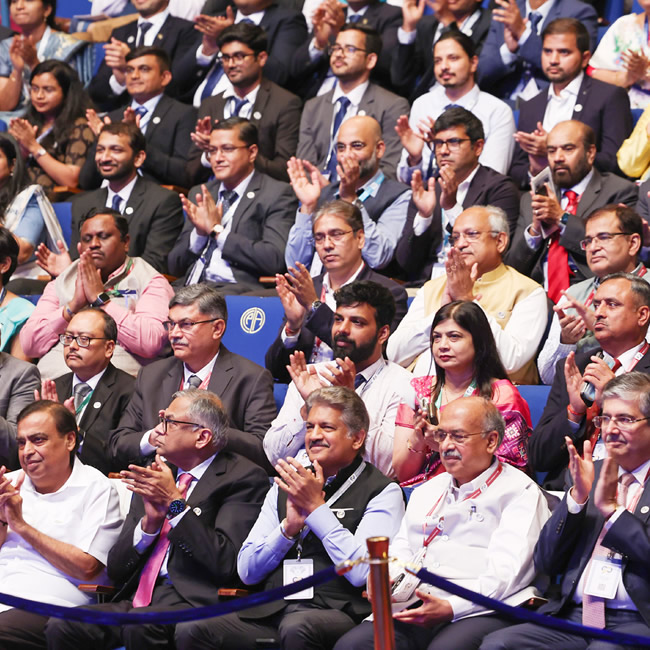
Photos: Prime Minister Modi attended the 90th-anniversary commemoration ceremony of the Reserve Bank of India in Mumbai, Maharashtra, on April 1, 2024. The gathering included India’s top industrialists, Finance Minister Nirmala Sitharaman, and RBI Governor Shaktikanta Das, among others.
Mumbai, India, April 1, 2024 — The Prime Minister, Shri Narendra Modi, delivered an inspiring address at the opening ceremony of RBI@90, a program celebrating 90 years of the Reserve Bank of India, in Mumbai, Maharashtra, today. Shri Modi also unveiled a commemorative coin to mark this significant milestone during the event. The Reserve Bank of India (RBI) commenced its operations on April 1, 1935, and today marks its 90th year.
In his address, the Prime Minister emphasized the historic significance of the RBI completing 90 years of service. He highlighted the RBI’s journey through pre- and post-independence eras and establishing a global reputation based on professionalism and commitment. The Prime Minister congratulated all staff on this achievement and expressed optimism about the RBI’s current policies. He also noted the importance of the next ten years leading up to RBI’s centenary year, emphasizing the RBI’s priority towards rapid growth, trust, and stability. Prime Minister Modi conveyed his best wishes for the RBI’s future goals and resolutions.
Source: Prime Minister’s Office
|GlobalGiants.Com|
Edited & Posted by the Editor | 12:46 PM | View the original post
March 31, 2024
The UNESCO Prize for Girls and Women's Education is now Open for 2024 Nominations.
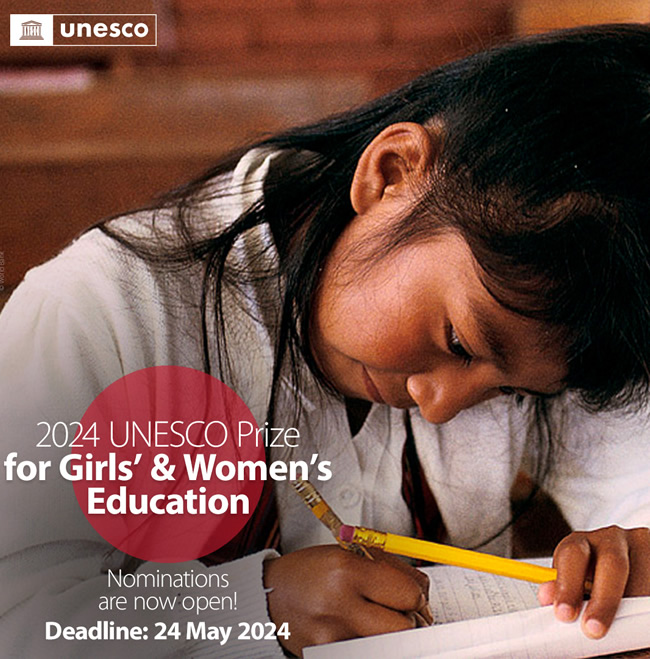
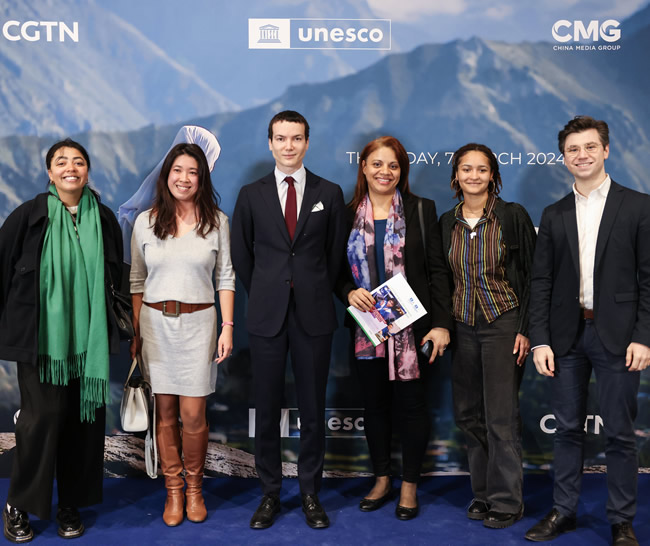
Photo: A group of participants at a meet on Education for Women. UNESCO Headquarters, Paris. March 7, 2024. Image provided by & copyright © UNESCO/Marie ETCHEGOYEN.
Paris, France, March 30, 2024 — On International Women’s Day, UNESCO launched the Call for Nominations for the 2024 UNESCO Prize for Girls and Women’s Education. The Prize awards US$50,000 annually to two laureates who make outstanding efforts toward girls’ and women’s education.
At the Transforming Education Summit in 2022, countries called for actions that put gender equality at the heart of education plans, budgets, and policies as part of their commitment to transforming education for the world we live in today.
It means promoting gender equality in curricula and pedagogies, creating safe, inclusive, and transformative learning spaces, supporting collaboration across sectors and generations, and investing in the most marginalized.
The Governments of UNESCO Member States can make the nominations. They can nominate up to three individuals, institutions, or organizations who have made solid and innovative contributions to girls’ and women’s education.
Interested candidates should contact their country’s National Commission for UNESCO, Permanent Delegation to UNESCO, or the Prize Secretariat for more information.
Nominations must meet the eligibility and selection criteria set by the Prize. Nominated projects must have been established and running for at least two years, showing potential for replicable and scalable growth.
An independent International Jury of five experts will assess nominations based on the project’s impact, innovation, and sustainability prospects.
Based on the jury’s recommendations, the Director-General of UNESCO will announce the 2024 laureates, who will receive the award on or around October 11, 2024, as part of the International Day of the Girl celebrations.
The submission deadline is May 24, 2024 (midnight, Paris time).
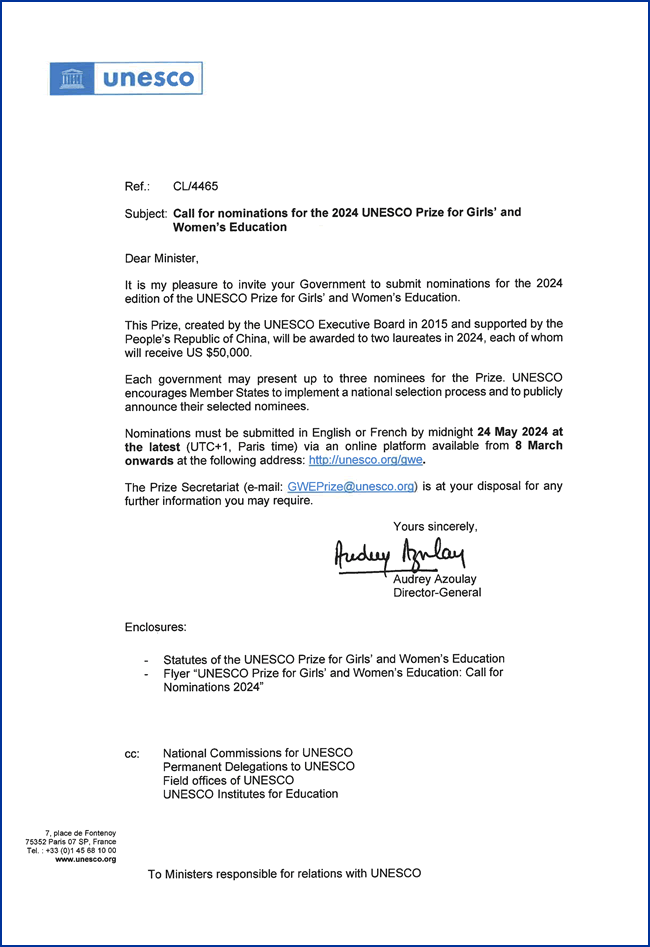
Photo: UNESCO Director-General’s letter to the Education Ministers of all Unesco Member Countries inviting Nominations for the UNESCO Prize for Girls and Women’s Education.
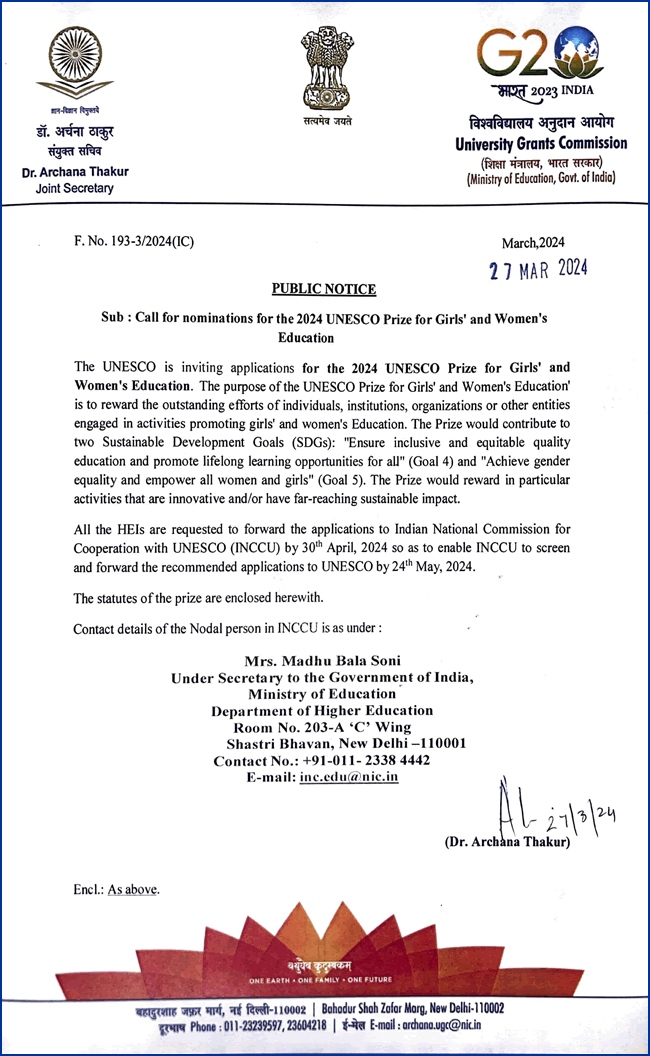
Photo: The University Grants Commission (UGC) India Public Notice announcing UNESCO’s Call for Nominations for the 2024 Girls and Women’s Education Prize. The UGC has advised all Higher Education Institutions to submit their nomination applications to the Indian National Commission for Cooperation with UNESCO (INCCU) by April 30, 2024. INCCU will then screen and forward the recommended nominations to UNESCO.
(The Indian National Commission for Cooperation with UNESCO (INCCU) is a part of the International Cooperation Cell within the Department of Higher Education, Ministry of Education, Government of India. The Minister of Education serves as the President of the Commission. The Secretary to the Government of India in the Department of Higher Education, Ministry of Education, acts as the Secretary-General of the Commission and is responsible for overseeing the work of the Commission.)
Sources: UNESCO; Department of Higher Education, Ministry of Education, Government of India.
|GlobalGiants.Com|
— The Editor is a UNESCO-IIEP-Certified Education Planning Consultant.
Edited & Posted by the Editor | 12:55 AM | View the original post
March 29, 2024
UNESCO delivers the Certificate for "Garba of Gujarat" to India.
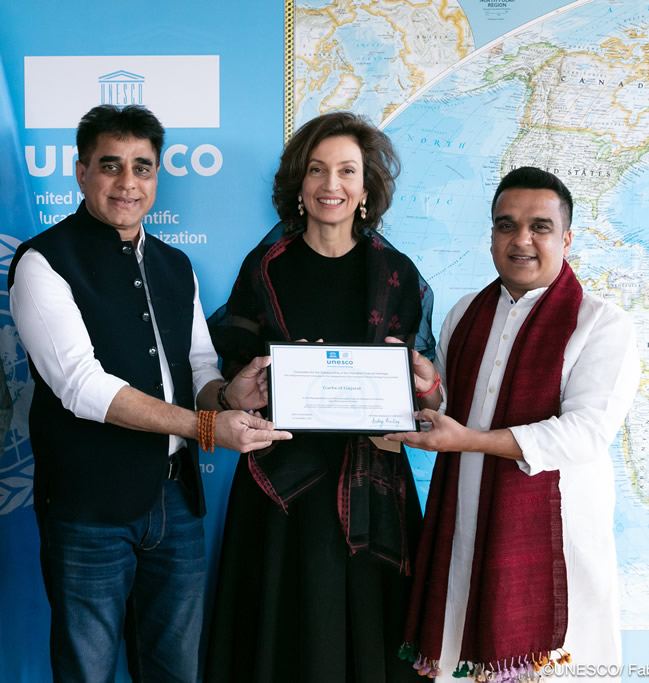
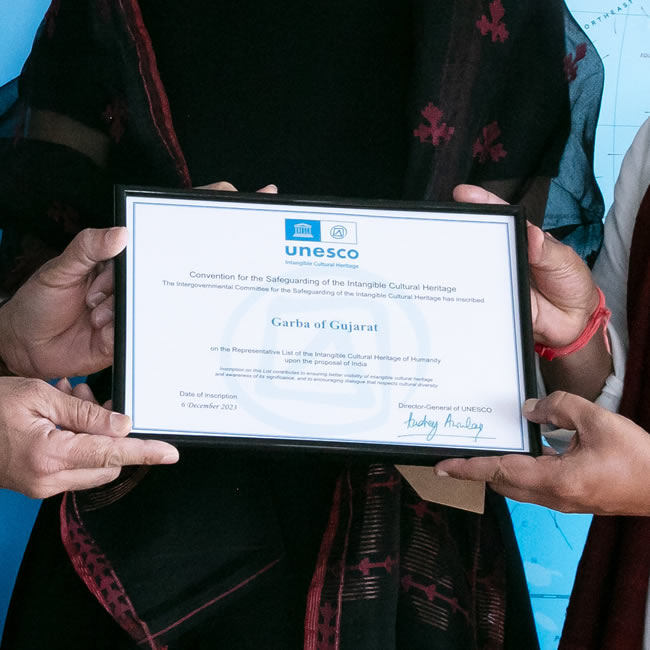

Photos: UNESCO delivers the Certificate for “Garba of Gujarat” to India. March 22, 2024. UNESCO Headquarters, Paris. Images provided by & copyright © UNESCO/Fabrice GENTILE.
Paris, France, March 29, 2024 — The Director-General of UNESCO delivered the “Garba of Gujarat” Certificate to India on March 22, 2024.
Recently, UNESCO declared the “Garba of Gujarat” as an intangible cultural heritage. This designation recognizes the role of Garba as a unifying force that fosters social and gender inclusivity. Garba is a dance form deeply rooted in ritualistic and devotional traditions that involve people from all walks of life.
The Evaluation Body of the 2003 Convention recognized India’s outstanding supporting material for the dossier. It acknowledged the importance of an element that champions unity in diversity and cultivates social equality among varied communities. UNESCO’s acknowledgment of inscribing an intangible cultural heritage element from Gujarat, Garba, will significantly elevate Garba’s global visibility and authentic essence.
The Prime Minister, Narendra Modi, expressed happiness on the inscription of the Garba of Gujarat on the Intangible Heritage List of UNESCO. He said, “Garba is a celebration of life, unity, and our deep-rooted traditions. Its inscription on the Intangible Heritage List showcases the beauty of Indian culture to the world. This honor inspires us to preserve and promote our heritage for future generations. Congrats on this global acknowledgment.”
Source: UNESCO
|GlobalGiants.Com|
Edited & Posted by the Editor | 1:22 PM | View the original post
March 28, 2024
Diamond Ring Maker Neil Lane participates in the Finale Episode of ABC's Hit Reality Series "The Bachelor"

Photo: Emerald & Shield Shaped Neil Lane Diamond Ring chosen by “The Bachelor” Joey Graziadei.

Photo: Oval Engagement Ring made by Neil Lane.

Photo: Joey Graziadei and Kelsey Anderson, participants in “The Bachelor,” final episode, with Kelsey wearing a Neil Lane Diamond Engagement Ring (Photo Credit: Disney/John Fleenor).
BEVERLY HILLS, Calif., March 28, 2024 — Diamond Ring Maker Neil Lane participated in the finale episode of ABC’s “The Bachelor.” The episode featured a stunning proposal from the newest Bachelor, Joey Graziadei, to Kelsey Anderson, set against the exquisite scenery of the beaches of Tulum, Mexico. This episode aired on Monday, March 25, on ABC.
On ABC’s hit primetime reality series “The Bachelor,” one lucky man gets the chance to find true love. A single and eligible bachelor embarks on a romantic journey, getting to know several beautiful women, gradually narrowing the field as he searches for his soul mate. At the end of the romantic journey, he proposes to his soulmate if he has found one. Warner Bros. produces the show.
In the final episode, Joey proposes to Kelsey with an emerald-cut stunner handmade in platinum. The diamond features two shield-shaped side stones, further accented by 18 round brilliant-cut diamonds. The approximate total weight of all 21 diamonds is 4 carats. They were designed and signed by Neil Lane.
Neil Lane is the go-to jeweler for Hollywood brides-to-be. He has designed engagement rings for stars like Reese Witherspoon, Kate Hudson, Jennifer Hudson, Jessica Simpson, Emily Blunt, and Miley Cyrus.
A fine jewelry designer with an eye for style and elegance, Neil Lane has earned the respect and admiration of leading film stars. From the Oscars to private celebrity events and red-carpet engagements, Neil Lane’s iconic pieces have adorned some of the most beautiful and influential women in Hollywood, including Angelina Jolie, Charlize Theron, Jennifer Lopez, Brie Larson, Anne Hathaway, Jennifer Lawrence, Gwyneth Paltrow, Jennifer Garner, Sofia Vergara, and Oprah Winfrey.
Source: Neil Lane
|GlobalGiants.Com|
Edited & Posted by the Editor | 11:59 PM | View the original post
March 27, 2024
UGC India instructs the Public and Students to Check a University's Relevant Status before enrolling in its Open and Distance Learning (ODL) or Online Learning (OL) Program.

New Delhi, India, March 24, 2024 — The University Grants Commission (UGC) has issued a Public Notice instructing the Public and students to check a university’s relevant status before enrolling in its open and distance learning (ODL) and online learning (OL) programs.
The University Grants Commission (UGC) has established regulations that set minimum standards of instruction for granting degrees and diplomas in ODL and Online mode. To ensure a positive learning experience, students should confirm the recognition status of the Higher Education Institution (HEI) offering ODL and Online education, check for prohibited programs and franchising arrangements, and ensure that the University conducts all activities or ODL programs within its territorial jurisdiction.
• Determining the Relevant Status of a Higher Educational Institution (HEI):
Recognition Status of the HEI: The UGC’s Distance Education Bureau (DEB) website provides the year-wise and academic session-wise status of HEIs recognized to offer programs through Open and Distance Learning (ODL) and Online Learning (OL) modes.
Entitlement Status of the HEI: The UGC’s Distance Education Bureau (DEB) website provides the list of HEIs entitled to offer programs in ODL and Online modes, along with the names of the programs.
• Check the details on the HEIs’ website: All Higher Education Institutions (HEIs) recognized and entitled to offer Open and Distance Learning (ODL) and online programs are required to upload details including:
- Application submitted to UGC
- Affidavit
- Statutory body approval
- Regulatory authority approval
Students should thoroughly review the above information on their University’s Website.
• Further, the students must check which HEIs are prohibited from offering ODL or Online programs and are classified as ‘No Admission’ institutions.
• Additionally, students must ensure that the ODL and Online courses they enroll in strictly adhere to the UGC notification on Specification of Degrees, 2014, and its subsequent amendments regarding minimum duration, nomenclature, and entry-level qualifications.
• Conduct of Activities within the Territorial Jurisdiction of the University:
- Furthermore, Students must ensure that the University conducts all activities, including admissions, counseling, contact programs, program delivery, and examinations for ODL programs within its territorial jurisdiction.
• The University Grants Commission (UGC) prohibits specific disciplines from being offered under Open and Distance Learning (ODL) and Online modes. These include Engineering, Medical, Physiotherapy, Occupational Therapy, Pharmacy, Nursing, Dental, Architecture, Law, Agriculture, Horticulture, Hotel Management, Catering Technology, Culinary Sciences, Aircraft Maintenance, Visual Arts, Sports, and Aviation. Additionally, the UGC prohibits M.Phil and Ph.D. programs from being offered in ODL and Online modes.
• March 31, 2024, is the last date for admissions to all HEIs for ODL and Online Programmes for the academic sessions commencing February 2024.
Source: UGC
|GlobalGiants.Com|
Edited & Posted by the Editor | 2:04 AM | View the original post
March 25, 2024
Kendra Scott introduces Lab Grown Diamond Collection
— The company expands its product assortment with the newest collection, offering delicate jewelry styles designed for everyday use.

Photo: Kendra Scott introduces Lab Grown Diamond Collection. The company expands its product assortment with the newest collection, offering delicate jewelry styles designed for everyday use. Image provided by & copyright © Kendra Scott.
AUSTIN, Texas, March 25, 2024 — Kendra Scott, the lifestyle brand known for its innovative design and commitment to “Family, Fashion, and Philanthropy,” has introduced its Lab Grown Diamond Collection. Designed in Austin, Texas, and inspired by the brand’s goal of offering stylish jewelry to a broader audience, this new collection represents Kendra Scott’s latest effort to provide fine diamond styles at a more affordable price.
“We’re excited to introduce our Lab Grown Collection, a natural category addition as we continue to progress as a lifestyle brand and offer our customers another dynamic reason to shop with us,” said Founder, Executive Chairwoman, and Chief Creative Officer Kendra Scott. “We pride ourselves on putting the customer first, and we heard over the years that our customers wanted to shop with us for fine jewelry because they loved the company, they loved that we give back, and they wanted their jewelry collections to grow alongside our product assortment. Fine jewelry is as much a staple for your everyday as it is for life milestones, and we wanted to offer our customers who may be more accustomed to shopping with us at a lower price point an opportunity to expand their Kendra Scott collection.”
The collection’s diamonds are cultivated in a controlled laboratory environment, which allows for precise management of the stones’ clarity, cut, and production while also delivering cost savings to customers.
Kendra Scott LLC was founded in 2002 by Kendra Scott, who serves as the Founder, Executive Chairwoman, and Chief Creative Officer of her namesake lifestyle brand. The brand is known for its innovative designs, use of color, and signature shapes. Kendra Scott offers a wide range of products, including Fashion, Demi-Fine, Fine Jewelry, watches, engagement rings, fragrances, home accessories, and a men’s collection called Scott Bros. by Kendra Scott. The company follows a customer-centric approach with a network of 130 experiential stores and pop-up locations, partnerships with wholesale retailers such as Neiman Marcus, Nordstrom, Bloomingdale’s, and Dillard’s, and 850 specialty boutiques.
Source: Kendra Scott
|GlobalGiants.Com|
Edited & Posted by the Editor | 10:23 AM | View the original post
March 24, 2024
Happy Holi

Happy Holi
|GlobalGiants.Com|
Edited & Posted by the Editor | 2:22 PM | View the original post
NASA sets Coverage for Crew Launch; Trio to Join Expedition 70
— UPDATE —
• NASA Astronaut Tracy Dyson, Crewmates Safely En Route to Space Station

Photo: The Soyuz rocket launches to the International Space Station with Expedition 71 NASA astronaut Tracy Dyson, Roscosmos cosmonaut Oleg Novitskiy, and Belarus spaceflight participant Marina Vasilevskaya, onboard, Saturday, March 23, 2024, at the Baikonur Cosmodrome in Kazakhstan. Photo Credit: (NASA/Bill Ingalls)
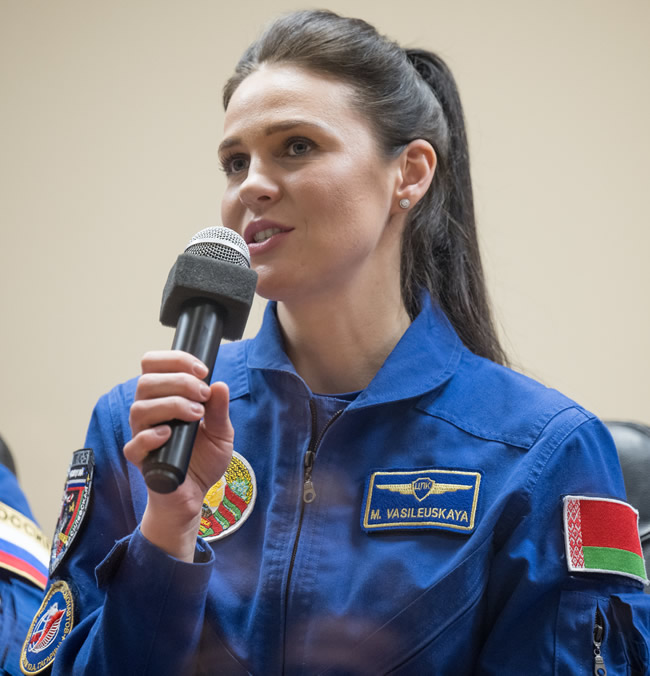
Photo: Belarus spaceflight participant Marina Vasilevskaya is seen behind glass during a press conference at the Cosmonaut Hotel in Baikonur, Kazakhstan, on Wednesday, March 20, 2024. Expedition 71 NASA astronaut Tracy Dyson, Roscosmos cosmonaut Oleg Novitskiy, and Belarus spaceflight participant Marina Vasilevskaya launched aboard their Soyuz MS-25 spacecraft on March 23. Photo Credit: (NASA/Bill Ingalls)

Photo: Belarus spaceflight participant Marina Vasilevskaya gives a thumbs-up as she waits to have her Russian Sokol suit pressure checked. She and crew mates Expedition 71 NASA astronaut Tracy Dyson and Roscosmos cosmonaut Oleg Novitskiy were preparing for their Soyuz launch to the International Space Station on Saturday, March 23, 2024, in Baikonur, Kazakhstan. Photo Credit: (NASA/Bill Ingalls)
WASHINGTON, March 23, 2024 — Three crew members, including NASA astronaut Tracy C. Dyson, successfully launched at 8:36 a.m. EDT Saturday from the Baikonur Cosmodrome in Kazakhstan to the International Space Station.
Dyson, along with her crewmates Roscosmos cosmonaut Oleg Novitskiy and spaceflight participant Marina Vasilevskaya of Belarus, will dock to the space station’s Prichal module at about 11:09 a.m. on Monday, March 25, on the Soyuz MS-25 spacecraft.
When the hatches between the station and the Soyuz open about 1:40 p.m., the new crew members will join NASA astronauts Loral O’Hara, Matthew Dominick, Mike Barratt, and Jeanette Epps, as well as Roscosmos cosmonauts Oleg Kononenko, Nikolai Chub, and Alexander Grebenkin, already living and working aboard the space station.
Novitskiy and Vasilevskaya will be aboard the station for 12 days before providing the ride home for O’Hara on Saturday, April 6, aboard Soyuz MS-24 for a parachute-assisted landing on the steppe of Kazakhstan.
Dyson will spend six months aboard the station as an Expedition 70 and 71 flight engineer, returning to Earth in September with Oleg Kononenko and Nikolai Chub of Roscosmos, who will complete a year-long mission on the laboratory.
It will be the third spaceflight for Dyson, the fourth for Novitskiy, and the first for Vasilevskaya.
Source: NASA
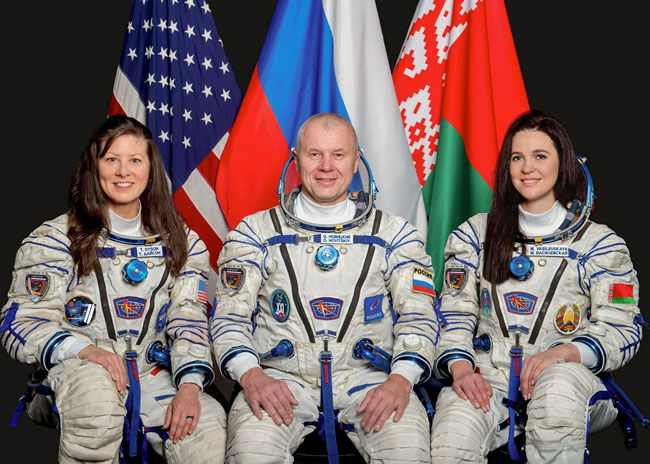
Photo: NASA astronaut Tracy C. Dyson, Roscosmos cosmonaut Oleg Novitskiy, and spaceflight participant Marina Vasilevskaya of Belarus pose for a portrait at the Gagarin Cosmonaut Training Center on November 2, 2023. Credits: GCTC/Andrey Shelepin.

Photo: Expedition 71 Soyuz Rollout. The Soyuz rocket is seen shortly after being rolled out to the launch pad at Site 31 on Monday, March 18, 2024, at the Baikonur Cosmodrome in Kazakhstan. Expedition 71 NASA astronaut Tracy Dyson, Roscosmos cosmonaut Oleg Novitskiy, and Belarus spaceflight participant Marina Vasilevskaya are scheduled to launch aboard their Soyuz MS-25 spacecraft on March 21. Photo Credit: (NASA/Bill Ingalls)
WASHINGTON, March 18, 2024 — Three crew members will blast off on Thursday, March 21, to support Expedition 70 aboard the International Space Station. NASA will provide complete launch and crew arrival coverage at the microgravity laboratory.
NASA astronaut Tracy C. Dyson, Roscosmos cosmonaut Oleg Novitskiy, and spaceflight participant Marina Vasilevskaya of Belarus will lift off on the Roscosmos Soyuz MS-25 spacecraft from the Baikonur Cosmodrome in Kazakhstan at 9:21 a.m. EDT.
Dyson, Novitskiy, and Vasilevskaya will journey to the station on a two-orbit, three-hour trajectory, resulting in docking to the station’s Prichal module at 12:39 p.m.
Shortly after, hatches between the station and the Soyuz will open, and the new crew members will connect with NASA astronauts Loral O’Hara, Matthew Dominick, Mike Barratt, and Jeanette Epps, as well as Roscosmos cosmonauts Oleg Kononenko, Nikolai Chub, and Alexander Grebenkin, already living and working aboard the space station.
Dyson will spend six months aboard the station as an Expedition 70 and 71 flight engineer, returning to Earth in September with Oleg Kononenko and Nikolai Chub of Roscosmos, who will complete a year-long mission on the laboratory.
Novitskiy and Vasilevskaya will be aboard the station for 12 days, providing the ride home for O’Hara on Tuesday, April 2, aboard Soyuz MS-24 for a parachute-assisted landing on the steppe of Kazakhstan. O’Hara will have spent 200 days in space when she returns.
It will be the third spaceflight for Dyson, the fourth for Novitskiy, and the first for Vasilevskaya.
Source: NASA
|GlobalGiants.Com|
Edited & Posted by the Editor | 5:13 AM | View the original post
March 22, 2024
Tangier, Morocco, will be the Global Host City for International Jazz Day in 2024.
— Worldwide Celebration on April 30, 2024
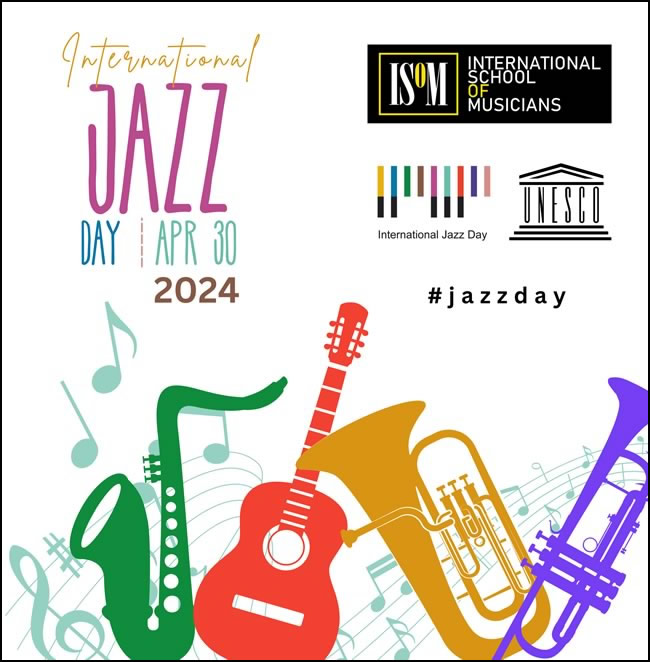
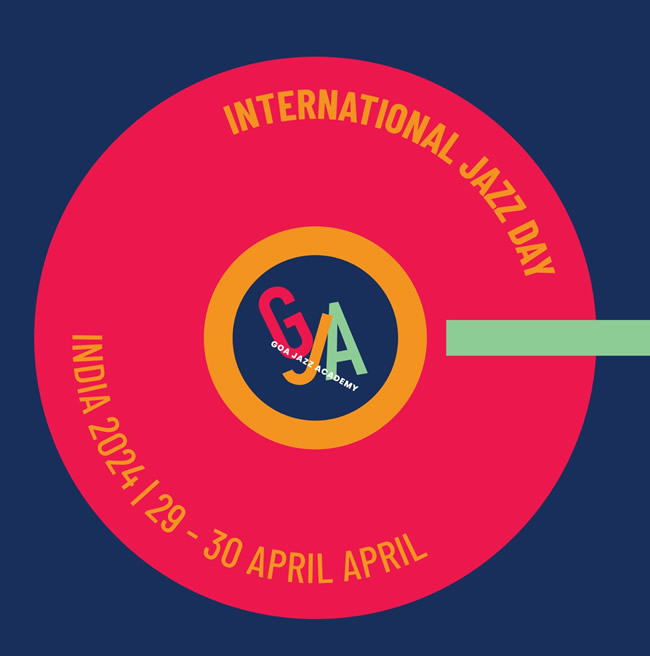


Photos: International Jazz Day 2024 Posters from various countries.
PARIS and WASHINGTON, March 19, 2024 — More than 190 countries will celebrate the upcoming edition of International Jazz Day on April 30, 2024. UNESCO Director-General Audrey Azoulay and UNESCO Goodwill Ambassador Herbie Hancock announced that Tangier, Morocco, will be the Global Host of the event. The city will serve as the anchor for all International Jazz Day programs taking place around the world.
“Tangier’s designation marks the first time a city on the African continent will host International Jazz Day, the world’s largest and most significant celebration of jazz,” said Audrey Azoulay, Director-General of UNESCO.
In collaboration with the Ministry of Culture of Morocco and the City of Tangier, a four-day celebration will take place from April 27-30, highlighting the city’s jazz heritage and promoting cultural and artistic ties between people in Morocco, Europe, and Africa. The celebration will include a series of education programs with events for students of all ages, a special presentation showcasing the significance of Morocco’s Gnawa music and its connection with jazz, and conversations about the history of jazz and its impact on Tangier. The event will culminate with an All-Star Global Concert at the Palace of Arts and Culture of Tangier, broadcast worldwide on YouTube, Facebook, the United Nations, and UNESCO, reaching millions of viewers.
Music enthusiasts can look forward to a thrilling event in Tangier featuring legendary figures of jazz, blues, and more. This event will also be broadcast worldwide. Led by the iconic pianist Herbie Hancock and Musical Director John Beasley from the USA, the All-Star Global Concert will showcase performances by an international lineup of artists from all corners of the globe, including the master Gnawa musician Abdellah El Gourd from Morocco. Other confirmed artists include Claudia Acuña from Chile, Ambrose Akinmusire from the USA, Lakecia Benjamin from the USA, Richard Bona from Cameroon, Dee Dee Bridgewater from the USA, Moreira Chonguiça from Mozambique, Shemekia Copeland from the USA, Kurt Elling from the USA, Antonio Faraò from Italy, Melody Gardot from the USA, Jazzmeia Horn from the USA, JK Kim from the Republic of Korea, Magnus Lindgren from Sweden, Romero Lubambo from Brazil, Marcus Miller from the USA, Yasushi Nakamura from Japan, Tarek Yamani from Lebanon, and many more artists to be announced soon.
Tangier is a city located at the junction of Europe and Africa and is known for its diverse cultural expressions. Jazz has a long and rich history in Tangier, with many world-renowned jazz artists such as Josephine Baker, Ornette Coleman, Herbie Mann, and Archie Shepp having performed and spent time in the city. For many years, jazz master Randy Weston lived in Tangier, where he collaborated with Gnawa master Abdellah El Gourd to explore the roots of jazz and African music. Morocco’s traditional Gnawa music and jazz fusion, known as Gnawa-jazz, is widely appreciated across Morocco and beyond.
The International Jazz Day was established by UNESCO in 2011 and later recognized by the United Nations General Assembly. It is celebrated annually on April 30 and brings together countries and communities worldwide. The celebration highlights jazz’s power in promoting peace, facilitating dialogues among cultures, encouraging diversity, and respecting human dignity.
International Jazz Day has evolved into a worldwide movement that annually reaches over 2 billion people on all continents. The movement achieves this through education programs, performances, community outreach, radio, television, streaming services, and electronic, print, and social media. The Herbie Hancock Institute of Jazz is the primary nonprofit organization responsible for annually planning, promoting, and organizing International Jazz Day.
Source: Herbie Hancock Institute of Jazz
|GlobalGiants.Com|
Edited & Posted by the Editor | 7:19 AM | View the original post
UGC India asks Universities to prioritize the well-being of New Mothers within their Community and comply with National Minimum Standards for Creches.

New Delhi, India, March 20, 2024— The University Grants Commission (UGC) has informed the Vice-Chancellors of all Universities that the “Maternity Benefit Act, 2017” requires that all establishments with fifty or more employees provide a creche facility within a prescribed distance. The creche facility can be provided separately or along with shared facilities. Further, the Ministry of Women and Child Development (MWCD) has developed the National Guidelines for Setting Up and Running Creches under the “Maternity Benefit Act 2017.”
The UGC has asked all Higher Educational Institutions to adhere to the National Minimum Standards and Protocol for Creches (Operation and Management) outlined by the Ministry of Women and Child Development (MWCD). The UGC has also urged the Universities to inform their affiliated colleges of this requirement and ensure compliance.
• Universities and colleges must prioritize the well-being of their staff and students, focusing on new mothers within their community. Academic institutions are responsible for providing adequate support and resources for new mothers to help them balance their educational and family commitments.
Source: UGC
|GlobalGiants.Com|
• To support the academic aspirations of women, working parents, scholars, and students, the University Grants Commission (UGC) introduced a scheme a few years ago to provide daycare facilities for infants at universities on a payment basis. This initiative was a valuable resource for University employees and students away during the day. It gave them peace of mind that their infants were cared for in a safe and reliable environment. The scheme was also available to male employees, scholars, and students whose wives were working elsewhere. The UGC has discontinued this scheme.
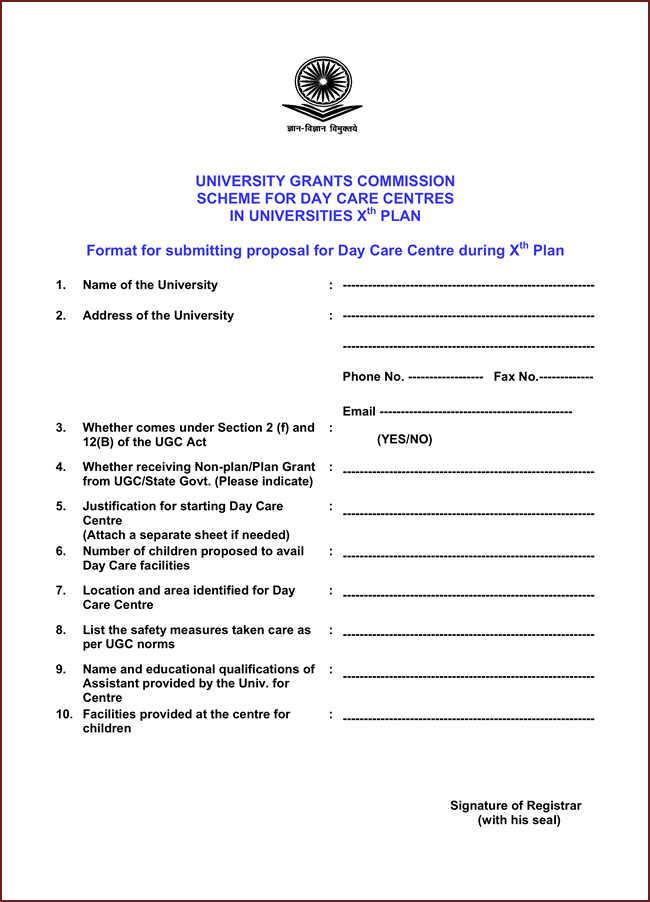
Photo: The format for submitting a proposal for a daycare center (for information only). Eligible universities could submit an application outlining their need for the facility. Once accepted, the UGC released the permissible amount. This scheme is no longer available.
Edited & Posted by the Editor | 2:34 AM | View the original post
March 21, 2024
Association of Indian Universities and EdifyOnline select Noodle's tech to power India's University Clusters Initiative.
— Clusters of higher education institutions will use the Noodle Learning Platform, which empowers universities to deliver online course offerings through a fully customizable platform.
NEW YORK, March 20, 2024 — The Association of Indian Universities (AIU) located in New Delhi, India, and Edify Online Corp (EdifyOnline) based in Birmingham, USA, have partnered with Noodle (Noodle), a technology company in New York, USA, to develop a shared ecosystem of lectures by global academic leaders and professors. This program will benefit the AIU’s 992 member universities, which serve over 5 million students. The Noodle Learning Platform (NLP) will be provided by Noodle, allowing universities to offer online courses through a fully customizable, LMS-agnostic all-in-one platform. The partners will work together to address the challenges, successes, and opportunities of implementing the program. Industry experts will review and publish the results to benefit all AIU members.
“With the help of EdifyOnline and Noodle’s NLP, AIU is preparing to enable a ‘shared HEIs ecosystem’ for AIU member universities to provide highly qualified and highly skilled international academic leaders at scalable and sustainable costs, as well as build bridges for Indian faculty to do the same for international HEIs in future,” said Secretary General of the AIU, Dr. Pankaj (Mrs.) Mittal.
Anil P. Agarwal, Co-Founder of EdifyOnline, believes that the Shared HEIs ecosystem is the future of higher education. It improves education standards and opportunities for all academic faculties, including those in India. Their mission is to ensure that everyone has the right to be enlightened, which supports the central theme of the Indian National Education Policy 2020. Agarwal is confident that their collaborative efforts with Noodle, AIU, and AIU member HEIs are timely, affordable, and synergistic.
“Our platform helps universities offer low-cost, high-quality education globally. Noodle empowers universities to transform the world with accessible and innovative education,” said John Katzman, Noodle’s CEO.
Dr. Amarendra Pani, the Joint Director and Director of the Research Division of AIU believes that the “University Clusters Pilot Study” in India will provide international exposure to students. The study will enable an ecosystem of shared lectures using international talent, triggering innovative ideas and processes leading to advanced research in higher education. He added that he and his research staff are looking forward to working with all stakeholders, including AIU member universities, to ensure the success of this pioneering initiative.
The Association of Indian Universities, founded in 1925, is India’s leading representative body for universities and higher education institutions. AIU membership comprises all types of universities, including conventional universities, open universities, deemed-to-be universities, state universities, central universities, private universities, and institutes of national importance. As of now, there are 992 university members of the AIU.
EdifyOnline provides a platform, EdifyProfessional®, where Higher Education Institutions (HEIs) can hire independent contractors for various academic roles such as instructors, guest lecturers, course content creators, professional development, and other specialized areas. The platform showcases highly qualified subject experts from around the globe. It is ideal for HEIs struggling with a lack of competent academic talent or seeking to expand their international competencies.
Noodle is a tech-enabled partner for higher education. As a Certified B Corporation, it helps academic institutions grow their online enrollments and build infrastructure. Noodle offers strategic consulting, customized services, and technology integration to make partners more efficient and responsive.
Source: Noodle
|GlobalGiants.Com|
Edited & Posted by the Editor | 6:19 AM | View the original post
March 18, 2024
U.S. Postal Service issues Garden Delights Stamps, celebrating Hummingbirds' vital role in Spring and Summer Gardens
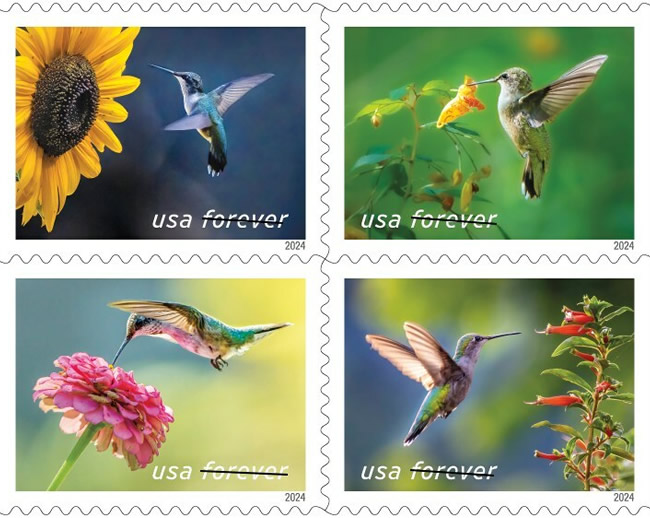
STRONGSVILLE, Ohio, March 18, 2024 — The United States Postal Service released a collection of four stamps called “Garden Delights.” These stamps celebrate the beautiful flora of America’s spring and summer gardens and acknowledge the crucial role of hummingbirds in pollination. Each stamp features a ruby-throated hummingbird gracefully hovering next to a zinnia, cigar flower, spotted touch-me-not, or sunflower. The ceremony to dedicate these stamps was held today in Strongsville.
The sight of spring flowers blooming is a delight for everyone, whether you’re an avid gardener or not. Gardens provide joy, food, and a sense of purpose to those who tend them and serve as a haven for birds, plants, and animals to find refuge and the necessary resources to survive.
No garden is complete without the buzzes, hums, and musical melodies of nature’s wildlife. Hummingbirds add charm to summer gardens with their unique features and small size.
Hummingbirds are exclusively found in the Americas, with around 16 species native to the United States. Among the smallest hummingbirds are the Ruby-throated ones, weighing about the same as a penny and measuring 3.5 inches long. These birds are the only hummingbirds found in the gardens of the eastern and central parts of the United States.
Hummingbirds are unique birds and remarkable pollinators. They can pollinate more than 7,000 flowering plants, which rely on them to collect and deliver the pollen necessary to produce fruit and seeds.
Greg Breeding used existing photographs by wildlife photographer Ben King to design the USPS stamps.
Source: U.S. Postal Service
|GlobalGiants.Com|
Edited & Posted by the Editor | 3:21 PM | View the original post
March 17, 2024
Lakme Fashion Week March 2024, in partnership with the Fashion Design Council of India (FDCI)





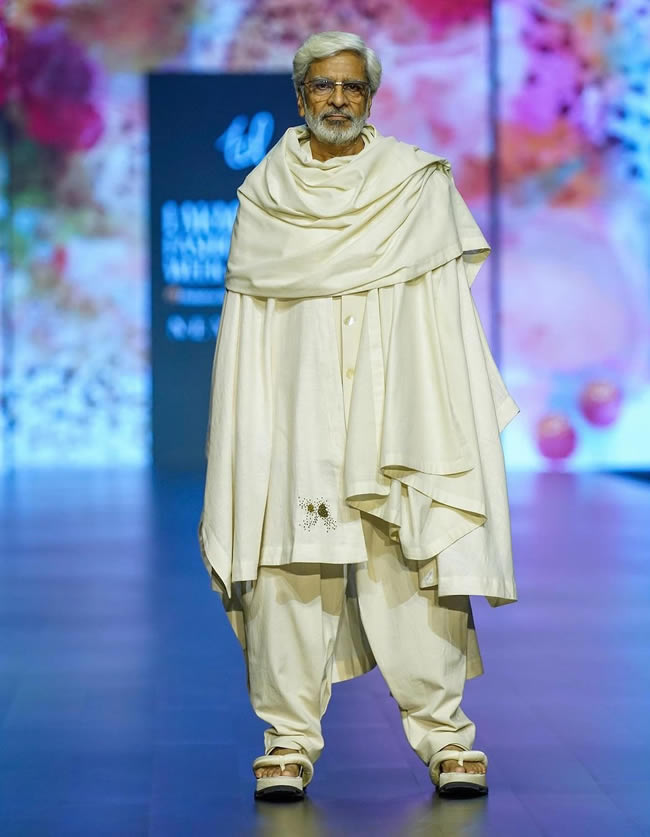

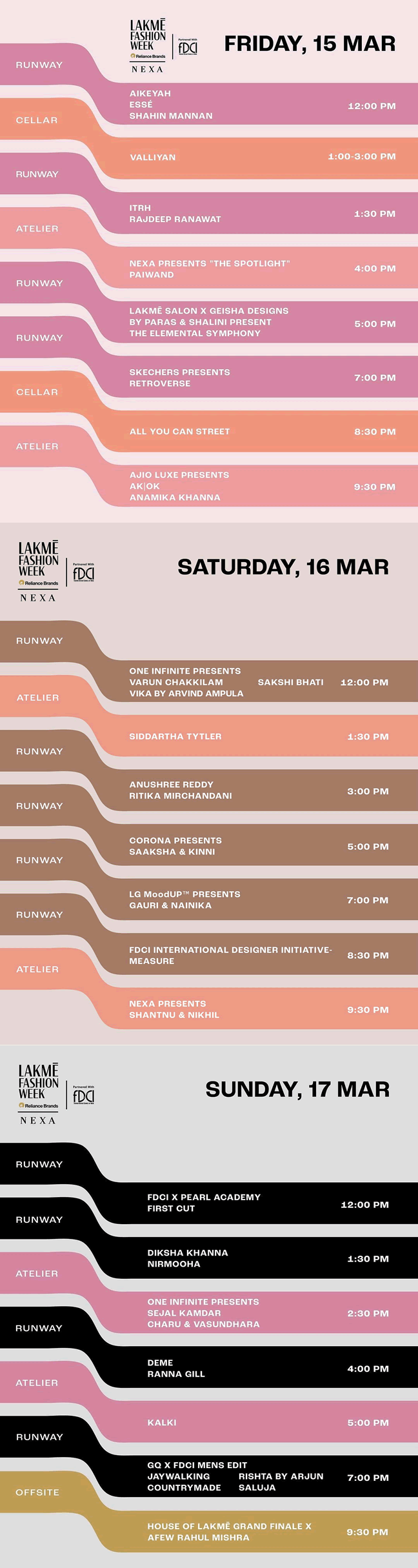
Photos: Sara Ali Khan. Models represent various designers. Lakme Fashion Week presented leading designers in partnership with the Fashion Design Council of India (FDCI). March 13-17, 2024. Images provided by FDCI/Lakme Fashion Week.
Mumbai, March 17, 2024 — Lakme Fashion Week, India’s premier fashion and lifestyle event, has been redefining fashion for over 25 years.
Over five days, over 100 designers, brands, and industry stakeholders showcase their work, making Lakmé Fashion Week the go-to destination for emerging talent, sustainability, and fashion businesses.
This season, Lakme Fashion Week and FDCI have combined their forces to present a joint schedule comprising the best curation and designers from Delhi, Mumbai, and across India.
Source: Fashion Design Council of India (FDCI) / Lakme Fashion Week.
|GlobalGiants.Com|
Check out the coolest vibrant looks and comfortable styles with @SkechersIndia @ILoveLakme @fdciofficial #reliancebrandsltd @R1SEWorldwide #UltimateFaceDefinition#SkechersAtLakmeFashionWeekxFDCl#Lakm?FashionWeekxFDCI #LFWxFDCI#Lakm?FashionWeek #LFW #FDCI #SkechersIndia pic.twitter.com/sKCqGXayLD
— Lakmé Fashion Week (@LakmeFashionWk) March 17, 2024
#janhvikapoor for KALKI on Day 5.@kalkifashion @ILoveLakme @fdciofficial #reliancebrandsltd @R1SEWorldwide #UltimateFaceDefinition#KalkiAtLakmeFashionWeekxFDCl#LakmeFashionWeekxFDCI #LFWxFDCI#Lakm?FashionWeek #LFW #FDCI#KALKIpresentsINARA #KALKIInara #SpringSummer24 pic.twitter.com/JeFScluLg8
— Lakmé Fashion Week (@LakmeFashionWk) March 17, 2024
Edited & Posted by the Editor | 1:13 AM | View the original post
March 15, 2024
Paris 2024 is on track to Welcome the World and deliver an Exceptional Games Vision.



Photos: Paris 2024 is on track to Welcome the World and deliver an Exceptional Games Vision. Images provided by and copyright © IOC Media Relations.
Paris, March 15, 2024 — The Organising Committee of the Paris 2024 Olympic Games is working hard to ensure everything is in place for the upcoming event. The Coordination Commission of the International Olympic Committee (IOC) has confirmed that the preparations are on track to welcome the Olympic Movement to France. The Commission had its final meeting before the Games, announcing that the Olympic Games Paris 2024 Opening Ceremony would start at 7:30 pm local time (CEST) on July 26.
The Coordination Commission Chair, Pierre-Olivier Beckers-Vieujant, confirmed that Paris 2024 is on track to deliver its exceptional Games vision. The Organising Committee is focused on delivering spectacular, impactful, and sustainable Games with the continued support of stakeholders. The Olympic Torch Relay begins in just over a month and will mark a key milestone in the Organising Committee’s operational activities. It will also amplify engagement and excitement as the Games draw nearer.
Beckers-Vieujant added that Paris 2024 sets an exemplary model for future Games. The engagement initiatives and new approaches align with the reforms of the Olympic Agenda 2020 that make the Games younger, more urban, more sustainable, and more inclusive. These Games will also be the first-ever Olympic Games with gender parity, with the same number of places allocated to female and male athletes by the IOC.
Paris 2024 President Tony Estanguet stressed the importance of remaining focused and humble as the Olympic flame approaches France in just 60 days. The team met with the IOC Coordination Commission for three days to review crucial details. Despite challenges over the past seven years, the team remains confident and proud of their ambition.
The Olympic Games Paris 2024 will begin on July 26 and continue until August 11.
Source: IOC Media Relations
|GlobalGiants.Com|
Edited & Posted by the Editor | 1:13 PM | View the original post
March 14, 2024
Oppenheimer wins Best Actor, Best Film, and Best Director at the 2024 Oscars.

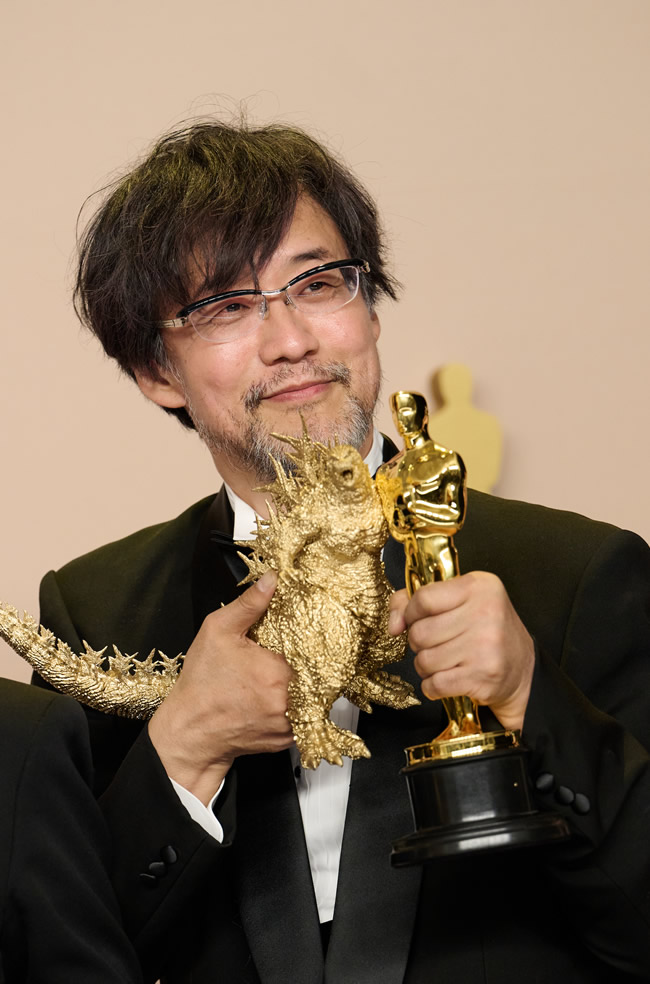
Photo: Takashi Yamazaki poses with the Oscar for Visual Effects during the live A.B.C. telecast of the 96th Oscars at the Dolby Theatre at Ovation Hollywood on Sunday, March 10, 2024. Image provided by Michael Baker / A.M.P.A.S., Copyright ©A.M.P.A.S.

Photo: Jennifer Lame poses backstage with the Oscar for Film Editing during the live ABC telecast of the 96th Oscars at Dolby Theatre at Ovation Hollywood on Sunday, March 10, 2024. Image provided by Michael Baker / A.M.P.A.S, Copyright ©A.M.P.A.S.
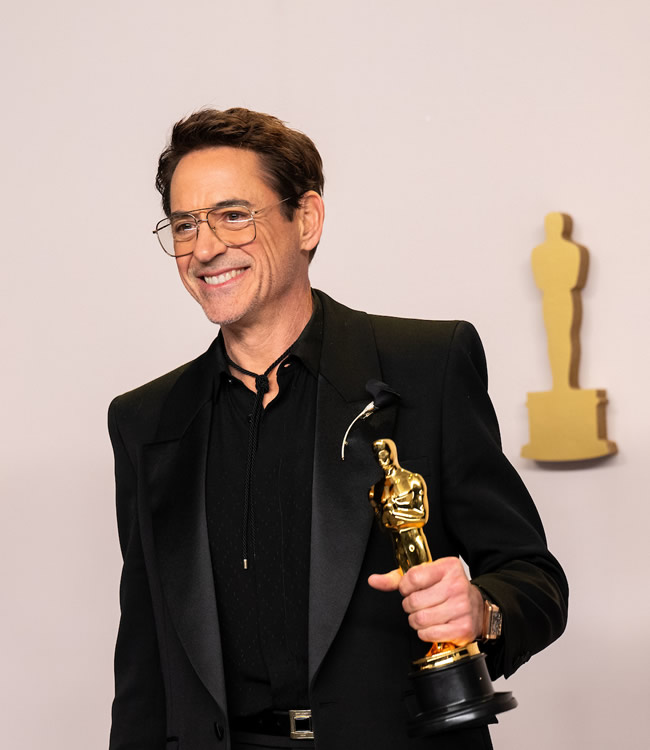
Photo: Robert Downey, Jr. poses backstage with the Oscar for Actor in a Supporting Role during the live A.B.C. telecast of the 96th Oscars at Dolby Theatre at Ovation Hollywood on Sunday, March 10, 2024. Image provided by Michael Baker / A.M.P.A.S., Copyright ©A.M.P.A.S.

Photo: Eva Longoria arrives on the red carpet of the 96th Oscars at the Dolby Theatre at Ovation Hollywood on Sunday, March 10, 2024. Image provided by Mke Baker / A.M.P.A.S., Copyright ©A.M.P.A.S.

Photo: America Ferrera arrives on the red carpet of the 96th Oscars at the Dolby Theatre at Ovation Hollywood on Sunday, March 10, 2024. Image provided by Kyusung Gong / A.M.P.A.S., Copyright ©A.M.P.A.S.
LOS ANGELES, CA, March 11, 2024 - The 96th Academy Awards ceremony, also known as the Oscars 2024, occurred on Sunday, March 10, 2024, at the Dolby Theatre in Hollywood. It was broadcast live on A.B.C. and in over 200 countries worldwide.
Oppenheimer, a biographical thriller directed by Christopher Nolan, was the big night winner, taking home seven awards, including Best Picture. Nolan and actors Cillian Murphy and Robert Downey Jr earned awards for Best Director, Best Actor, and Best Supporting Actor, respectively. The event ended with a flourish at the Ovation Hollywood in Los Angeles.
— The Full List of Oscar Winners 2024 —
• ACTOR IN A LEADING ROLE
WINNER
CILLIAN MURPHY
Oppenheimer
NOMINEES
BRADLEY COOPER
Maestro
COLMAN DOMINGO
Rustin
PAUL GIAMATTI
The Holdovers
JEFFREY WRIGHT
American Fiction
• ACTOR IN A SUPPORTING ROLE
WINNER
ROBERT DOWNEY JR.
Oppenheimer
NOMINEES
STERLING K. BROWN
American Fiction
ROBERT DE NIRO
Killers of the Flower Moon
RYAN GOSLING
Barbie
MARK RUFFALO
Poor Things
• ACTRESS IN A LEADING ROLE
WINNER
EMMA STONE
Poor Things
NOMINEES
ANNETTE BENING
Nyad
LILY GLADSTONE
Killers of the Flower Moon
SANDRA HÜLLER
Anatomy of a Fall
CAREY MULLIGAN
Maestro
• ACTRESS IN A SUPPORTING ROLE
WINNER
DA’VINE JOY RANDOLPH
The Holdovers
NOMINEES
EMILY BLUNT
Oppenheimer
DANIELLE BROOKS
The Color Purple
AMERICA FERRERA
Barbie
JODIE FOSTER
Nyad
• ANIMATED FEATURE FILM
WINNER
THE BOY AND THE HERON
Hayao Miyazaki and Toshio Suzuki
NOMINEES
ELEMENTAL
Peter Sohn and Denise Ream
NIMONA
Nick Bruno, Troy Quane, Karen Ryan, and Julie Zackary
ROBOT DREAMS
Pablo Berger, Ibon Cormenzana, Ignasi Estapé and Sandra Tapia Díaz
SPIDER-MAN: ACROSS THE SPIDER-VERSE
Kemp Powers, Justin K. Thompson, Phil Lord, Christopher Miller and Amy Pascal
• CINEMATOGRAPHY
WINNER
OPPENHEIMER
Hoyte van Hoytema
NOMINEES
EL CONDE
Edward Lachman
KILLERS OF THE FLOWER MOON
Rodrigo Prieto
MAESTRO
Matthew Libatique
POOR THINGS
Robbie Ryan
• COSTUME DESIGN
WINNER
POOR THINGS
Holly Waddington
NOMINEES
BARBIE
Jacqueline Durran
KILLERS OF THE FLOWER MOON
Jacqueline West
NAPOLEON
Janty Yates and Dave Crossman
OPPENHEIMER
Ellen Mirojnick
• DIRECTING
WINNER
OPPENHEIMER
Christopher Nolan
NOMINEES
ANATOMY OF A FALL
Justine Triet
KILLERS OF THE FLOWER MOON
Martin Scorsese
POOR THINGS
Yorgos Lanthimos
THE ZONE OF INTEREST
Jonathan Glazer
• DOCUMENTARY FEATURE FILM
WINNER
20 DAYS IN MARIUPOL
Mstyslav Chernov, Michelle Mizner, and Raney Aronson-Rath
NOMINEES
BOBI WINE: THE PEOPLE’S PRESIDENT
Moses Bwayo, Christopher Sharp, and John Battsek
THE ETERNAL MEMORY
Maite Alberdi
FOUR DAUGHTERS
Kaouther Ben Hania and Nadim Cheikhrouha
TO KILL A TIGER
Nisha Pahuja, Cornelia Principe and David Oppenheim
• DOCUMENTARY SHORT FILM
WINNER
THE LAST REPAIR SHOP
Ben Proudfoot and Kris Bowers
NOMINEES
THE ABCS OF BOOK BANNING
Sheila Nevins and Trish Adlesic
THE BARBER OF LITTLE ROCK
John Hoffman and Christine Turner
ISLAND IN BETWEEN
S. Leo Chiang and Jean Tsien
NAI NAI & WAI PO
Sean Wang and Sam Davis
• FILM EDITING
WINNER
OPPENHEIMER
Jennifer Lame
NOMINEES
ANATOMY OF A FALL
Laurent Sénéchal
THE HOLDOVERS
Kevin Tent
KILLERS OF THE FLOWER MOON
Thelma Schoonmaker
POOR THINGS
Yorgos Mavropsaridis
• INTERNATIONAL FEATURE FILM
WINNER
THE ZONE OF INTEREST
United Kingdom
NOMINEES
IO CAPITANO
Italy
PERFECT DAYS
Japan
SOCIETY OF THE SNOW
Spain
THE TEACHERS’ LOUNGE
Germany
• MAKEUP AND HAIRSTYLING
WINNER
POOR THINGS
Nadia Stacey, Mark Coulier, and Josh Weston
NOMINEES
GOLDA
Karen Hartley Thomas, Suzi Battersby, and Ashra Kelly-Blue
MAESTRO
Kazu Hiro, Kay Georgiou, and Lori McCoy-Bell
OPPENHEIMER
Luisa Abel
SOCIETY OF THE SNOW
Ana López-Puigcerver, David Martí and Montse Ribé
• MUSIC (ORIGINAL SCORE)
WINNER
OPPENHEIMER
Ludwig Göransson
NOMINEES
AMERICAN FICTION
Laura Karpman
INDIANA JONES AND THE DIAL OF DESTINY
John Williams
KILLERS OF THE FLOWER MOON
Robbie Robertson
POOR THINGS
Jerskin Fendrix
• MUSIC (ORIGINAL SONG)
WINNER
WHAT WAS I MADE FOR?
from Barbie; Music and Lyric by Billie Eilish and Finneas O’Connell
NOMINEES
THE FIRE INSIDE
from Flamin’ Hot; Music and Lyric by Diane Warren
I’M JUST KEN
from Barbie; Music and Lyric by Mark Ronson and Andrew Wyatt
IT NEVER WENT AWAY
from American Symphony; Music and Lyric by Jon Batiste and Dan Wilson
WAHZHAZHE (A SONG FOR MY PEOPLE)
from Killers of the Flower Moon; Music and Lyric by Scott George
• BEST PICTURE
WINNER
OPPENHEIMER
Emma Thomas, Charles Roven, and Christopher Nolan, Producers
NOMINEES
AMERICAN FICTION
Ben LeClair, Nikos Karamigios, Cord Jefferson, and Jermaine Johnson, Producers
ANATOMY OF A FALL
Marie-Ange Luciani and David Thion, Producers
BARBIE
David Heyman, Margot Robbie, Tom Ackerley and Robbie Brenner, Producers
THE HOLDOVERS
Mark Johnson, Producer
KILLERS OF THE FLOWER MOON
Dan Friedkin, Bradley Thomas, Martin Scorsese and Daniel Lupi, Producers
MAESTRO
Bradley Cooper, Steven Spielberg, Fred Berner, Amy Durning and Kristie Macosko Krieger, Producers
PAST LIVES
David Hinojosa, Christine Vachon and Pamela Koffler, Producers
POOR THINGS
Ed Guiney, Andrew Lowe, Yorgos Lanthimos and Emma Stone, Producers
THE ZONE OF INTEREST
James Wilson, Producer
• PRODUCTION DESIGN
WINNER
POOR THINGS
Production Design: James Price and Shona Heath; Set Decoration: Zsuzsa Mihalek
NOMINEES
BARBIE
Production Design: Sarah Greenwood; Set Decoration: Katie Spencer
KILLERS OF THE FLOWER MOON
Production Design: Jack Fisk; Set Decoration: Adam Willis
NAPOLEON
Production Design: Arthur Max; Set Decoration: Elli Griff
OPPENHEIMER
Production Design: Ruth De Jong; Set Decoration: Claire Kaufman
• ANIMATED SHORT FILM
WINNER
WAR IS OVER! INSPIRED BY THE MUSIC OF JOHN & Y.O.K.O.
Dave Mullins and Brad Booker
NOMINEES
LETTER TO A PIG
Tal Kantor and Amit R. Gicelter
NINETY-FIVE SENSES
Jerusha Hess and Jared Hess
OUR UNIFORM
Yegane Moghaddam
PACHYDERME
Stéphanie Clément and Marc Rius
• LIVE ACTION SHORT FILM
WINNER
THE WONDERFUL STORY OF HENRY SUGAR
Wes Anderson and Steven Rales
NOMINEES
THE AFTER
Misan Harriman and Nicky Bentham
INVINCIBLE
Vincent René-Lortie and Samuel Caron
KNIGHT OF FORTUNE
Lasse Lyskjær Noer and Christian Norlyk
R.E.D., WHITE AND BLUE
Nazrin Choudhury and Sara McFarlane
• SOUND
WINNER
THE ZONE OF INTEREST
Tarn Willers and Johnnie Burn
NOMINEES
THE CREATOR
Ian Voigt, Erik Aadahl, Ethan Van der Ryn, Tom Ozanich and Dean Zupancic
MAESTRO
Steven A. Morrow, Richard King, Jason Ruder, Tom Ozanich, and Dean Zupancic
MISSION: IMPOSSIBLE - DEAD RECKONING PART ONE
Chris Munro, James H. Mather, Chris Burdon, and Mark Taylor
OPPENHEIMER
Willie Burton, Richard King, Gary A. Rizzo, and Kevin O’Connell
• VISUAL EFFECTS
WINNER
GODZILLA MINUS ONE
Takashi Yamazaki, Kiyoko Shibuya, Masaki Takahashi and Tatsuji Nojima
NOMINEES
THE CREATOR
Jay Cooper, Ian Comley, Andrew Roberts, and Neil Corbould
GUARDIANS OF THE GALAXY VOL. 3
Stephane Ceretti, Alexis Wajsbrot, Guy Williams, and Theo Bialek
MISSION: IMPOSSIBLE - DEAD RECKONING PART ONE
Alex Wuttke, Simone Coco, Jeff Sutherland, and Neil Corbould
NAPOLEON
Charley Henley, Luc-Ewen Martin-Fenouillet, Simone Coco, and Neil Corbould
• WRITING (ADAPTED SCREENPLAY)
WINNER
AMERICAN FICTION
Written for the screen by Cord Jefferson
NOMINEES
BARBIE
Written by Greta Gerwig & Noah Baumbach
OPPENHEIMER
Written for the screen by Christopher Nolan
POOR THINGS
Screenplay by Tony McNamara
THE ZONE OF INTEREST
Written by Jonathan Glazer
• WRITING (ORIGINAL SCREENPLAY)
WINNER
ANATOMY OF A FALL
Screenplay - Justine Triet and Arthur Harari
NOMINEES
THE HOLDOVERS
Written by David Hemingson
MAESTRO
Written by Bradley Cooper & Josh Singer
MAY DECEMBER
Screenplay by Samy Burch; Story by Samy Burch & Alex Mechanik
PAST LIVES
Written by Celine Song
Source: The Academy of Motion Picture Arts and Sciences
— The Academy snubbed India’s official International Feature Film entry for the 2024 Oscars: “2018: Everyone is a Hero.”
|GlobalGiants.Com|
Edited & Posted by the Editor | 7:15 PM | View the original post
Coca-Cola introduces 'Coca-Cola Foodmarks' to India, incorporating Raj Kapoor's legacy.


Photo: Coca-Cola launches Foodmarks with Bollywood icons Karisma Kapoor and Janhvi Kapoor. Image provided by Coca-Cola India.
New Delhi, India, March 14, 2024 — Coca-Cola India is introducing Coca-Cola Foodmarks in India as part of its global campaign, ‘A Recipe for Magic.’ This campaign celebrates the unique culinary experiences around the world that Coca-Cola enhances. Coca-Cola Foodmarks features global ‘food landmarks,’ destinations, and experiences that are ideal when you have the perfect moment, a delicious meal, and an ice-cold Coca-Cola.
The Coca-Cola Company made the global rollout of this product launch in India at the Embassy restaurant in the iconic Connaught Place in Delhi. The event was nostalgic, reminiscent of Hindi Cinema’s pivotal era. Bollywood celebrities Janhvi Kapoor and Karisma Kapoor attended the event, making it even more special. The event’s highlight was a timeless photograph featuring two icons, Raj Kapoor and a bottle of Coke, both captured in one frame.
The Coca-Cola Foodmarks experience transported the guests back to the golden age of Bollywood in the 1950s, evoking the atmosphere of Raj Kapoor’s on-set meal moments. The immersive film set was complemented by interactive moments using cutting-edge A.I. technology, taking guests through Bollywood. The decor, which included stardom posters and a musical stairway, added to the ambiance, while extraordinary photo backdrops provided the perfect photo opportunities. The evening was made even more enchanting by the arrival of the Kapoor stars in vintage cars, which added to the overall charm of the event. Local influencers and dignitaries also attended to experience the magic of Coca-Cola Foodmarks.
“We are excited to announce the launch of Coca-Cola Foodmarks in India, a country with a rich culinary heritage and vibrant food culture,” said Kaushik Prasad, Senior Director of Marketing at Coca-Cola INSWA. “Coca-Cola Foodmarks embodies the essence of Coca-Cola, which is to spread the real magic of shared moments, cultural nuances, and culinary excellence. We are thrilled to offer this experience to our patrons, allowing them to savor unique flavors while creating lasting memories.”
As part of the campaign, Coca-Cola will debut immersive, in-person experiences worldwide, showcasing unique experiences, each inspired by an iconic cultural moment.
Coca-Cola is a renowned beverage company in India that offers consumers a diverse range of high-quality and refreshing drink options. The company is committed to providing “Beverages For Life” and has an extensive portfolio of products that includes hydration, sports, sparkling, coffee, tea, nutrition, juice, and dairy-based beverages. Coca-Cola’s beverage range in India comprises Coca-Cola, Coca-Cola Zero Sugar, Diet Coke, Thums Up, Charged by Thums Up, Fanta, Limca, Sprite, Maaza, Minute Maid juices, and juice-based beverages. The company also offers hydration beverages such as Limca Sportz, Smartwater, Kinley, Dasani, Bonaqua packaged drinking water, and Kinley Club Soda. Schweppes range and Smartwater are premium products. In addition, the company provides Costa Coffee and Honest Tea, an organic green tea-based beverage, among its coffee and tea offerings. Coca-Cola is continually revamping its portfolio by reducing sugar in its drinks and introducing innovative products.
Globally, along with its bottling partners, The Coca-Cola Company employs over 700,000 people worldwide, providing economic opportunities to local communities.
Source: The Coca-Cola Company
|GlobalGiants.Com|
Edited & Posted by the Editor | 9:42 AM | View the original post
Panjab University Chandigarh averts its inclusion in the UGC's "Defaulting Universities" list by fully complying with the University Grants Commission (Redressal of Grievances of Students) Regulations and duly appointing an Ombudsperson.
UPDATE
MARCH 14, 2024
UGC has published a Public Notice and released an updated list of Defaulting Universities that have still not appointed Ombudspersons in compliance with the University Grants Commission (Redressal of Grievances of Students) Regulations, 2023.
• Updated List of Defaulting State Universities as of March 12, 2024.

Photo: Gandhi Bhawan, Panjab University Chandigarh (Photo for Representation).
MANDATORY
• Each University must appoint an Ombudsperson to address the grievances of students enrolled in the University and affiliated colleges/institutions.
UNIVERSITY’S PENCHANT FOR HARASSING & VICTIMIZING
• The grievances include non-transparent or unfair evaluation practices and the University’s penchant for harassing and victimizing students.
MUST DISPLAY OMBUDSPERSON DETAILS
• Per the UGC regulations, each University and its affiliated colleges must display the particulars and contact details of the Ombudsperson and students’ grievance redressal committee (SGRC) on their websites and at prominent places on their campuses.
CONSEQUENCES OF NON-COMPLIANCE
• If an institution willfully contravenes these regulations, the UGC will take one or more of the following actions:
Withdrawing declaration of fitness to receive grants under section 12B of the UGC Act.
Withholding any grant allocated to the Institution.
Declaring the Institution ineligible for consideration for any assistance under any of the Commission’s general or special assistance programs.
Declaring the Institution ineligible to offer courses through Online/ODL mode for a specified period.
Withdrawing/withholding/suspending the approval for offering courses through Online/ODL mode.
Informing the general public, including potential candidates for admission, through a notice displayed prominently in suitable media and posted on the Commission’s website, declaring that the Institution does not possess the minimum standards for redressal of grievances.
Recommending the State Government to take necessary and appropriate action if a University is established or incorporated under a State Act.
New Delhi, India, January 31, 2023 — On April 11, 2023, UGC notified the University Grants Commission (Redressal of Grievances of Students) Regulations, 2023, in the Official Gazette of India. Following this, the UGC sent a letter to the University Vice-Chancellors asking them to appoint ombudspersons within 30 days.
The UGC again wrote to the Vice-Chancellors of all Universities and asked them to implement the University Grants Commission (Redressal of Grievances of Students) Regulations, 2023, and appoint Ombudspersons on or before December 31, 2023.
The UGC told the universities that they must comply with the Regulations, and if a university continues to be non-compliant, the UGC will take punitive action against it.
On January 17, 2024, the UGC released a “Public Notice” listing the “Defaulting Universities” that have failed to appoint Ombudspersons.
The list contained the names of more than 200 Universities that defaulted on appointing Ombudspersons per the regulations.
In its January 17, 2024, “Public Notice,” the UGC directed that those universities who appoint Ombudsperson (s) subsequently may communicate it to the UGC so that it may remove their name from the “Defaulters” list.
Meanwhile, Panjab University at Chandigarh has fully complied with the UGC directive on the University Grants Commission (Redressal of Grievances of Students) Regulations, 2023. It has constituted a Student Grievances Redressal Committee (SGRC) and has duly appointed an Ombudsperson.
Thus, it has averted getting branded a “Defaulter” by the UGC. Consequently, the name of Panjab University Chandigarh does not appear on UGC’s “Defaulting Universities” list.
However, per the directives of the UGC, Panjab University and its affiliated colleges must prominently display the contact details of the Student Grievances Redressal Committee (SGRC) and the Ombudsperson on their campuses.
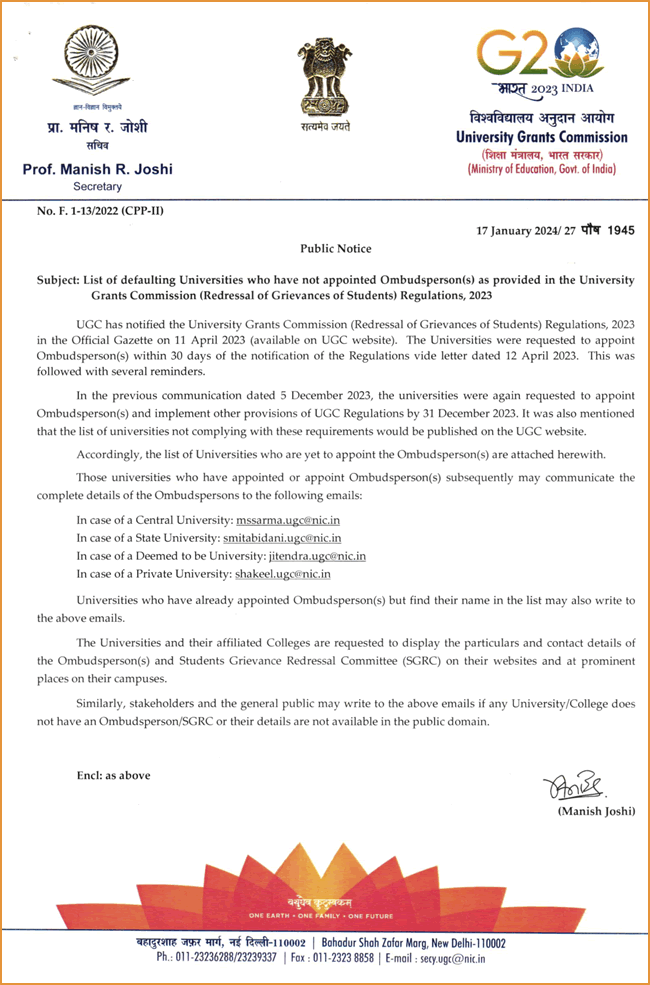
Photo: UGC Public Notice announcing the List of Defaulting Universities that have not appointed Ombudspersons in compliance with the University Grants Commission Redressal of Grievances of Students Regulations, 2023.
Source: UGC
|GlobalGiants.Com|
Edited & Posted by the Editor | 5:14 AM | View the original post